Session
Organizer 1: Civil Society, Western European and Others Group (WEOG)
Organizer 2: Intergovernmental Organization, Intergovernmental Organization
Speaker 1: Alexis Roussel, Civil Society, Western European and Others Group (WEOG)
Speaker 2: Jesselyn Radack, Civil Society, Western European and Others Group (WEOG)
Speaker 3: Alexander Isavnin, Technical Community, Eastern European Group
Round Table - U-shape - 90 Min
Trust and identity: Is the Digital Integrity of the human person a fundamental right?
Surveillance, Data protection, privacy, human rights, and human autonomy
GOAL 3: Good Health and Well-Being
GOAL 4: Quality Education
GOAL 8: Decent Work and Economic Growth
GOAL 9: Industry, Innovation and Infrastructure
GOAL 16: Peace, Justice and Strong Institutions
Description:
This workshop will introduce this new legal concept, its possible implications for data protection, and how this concept could be introduced into the current legal framework. The right to digital integrity is to be understood as the general justification for all human digital rights including the right to data protection. Every human evolves today in a multi-dimensional physical and digital environment. If each individual is to keep their individuality and autonomy in their daily choices, they must be protected and given effective tools to defend their own autonomy. Recognizing that human life has been digitally extended means questioning ourselves on what makes us human today. Should personal data be considered as a component of the person, rather than objects that can be owned by whoever collects that data? Should our digital integrity be protected? If each human person already has a right to physical and mental integrity as stated in the Swiss Constitution article 10 al.2 or in the Charter of fundamental rights of the European Union, article 3.1, shouldn't they have a right to digital integrity? During the workshop we will describe the current initiative to integrate the Right to Digital Integrity in existing legal frameworks: The addition of this new right will be discussed by the Walliser Verfassungsrat in charge of writing the new Cantonal Constitution. It was already adopted by the Commission of Fundamental Rights of the Constitution Assembly: There are now efforts to bring this Right into the Charter of fundamental rights of the European Union, article 3.1 through discussion being initiated at the European Parliament. The workshop will also explore the social implication of a society where data is not an object that can be solved, but an element of human, similar to organs, with inalienable rights. The association of French speaking Data Protection Authorities, including the Swiss authority and the French CNIL, has issued a comment that "personal data are components of the human person" This model proposes a fundamental alternative to the application of property rights or copyright on personal data, or as well the application of the notion of the common good to personal data. The workshop will also explore the development of doctrine on this subject: The University of Neuchâtel in Switzerland has dedicated a conference on the topic, with scholars exploring the impact of the right to digital integrity in different legal fields of study.
This workshop aims to raise awareness about a new legal concept and its approach to human rights. The presentation material as well as the video stream will be made available. Collaboration with organisations from civil society organisations that are concerned with human rights development after IGF is planned
We plan to include the audience into discussion, also taking questions from the internet.
Relevance to Internet Governance: The right to digital integrity, when guaranteed in Constitution or other human rights legislations, will create an unopposable right for individuals to request that internet governance is always conceived and executed in respect to each individuals' integrity. The government will create legislation to encourage private sectors to act accordingly also. This promotes a purely human centric approach of internet governance.
Relevance to Theme: Assurance of (self) digital integrity will enhance trust in Governmental Institutions, Platforms, and organizations processing data.
Usage of IGF Official Tool. Additional Tools proposed: Twitter hashtag
Report
The areas of broad support and agreement were:
- There is a need for quality protection of Humans from digital technology misuses.
- The protection must take the risk of fragmentation of the internet into account.
- Aspects of a person's identity and it's digital identity are not separate from the "real world".
- Recognizing the digital integrity as an extension of bodily and mental integrity enable a novel vision on the protection of individuals.
Areas of no agreement/areas needing further discussion and development:
- Some might view the extension of such rights within Human Rights within the context of criticism of the biased nature of a Human Rights approach.
- This vision where personal data are constituting elements of the individual is contradicting regional approaches where personal data is considered as a commodity, or where personal data is considered as a common good to be managed by the authorities.
- Some fear it could lead to stricter regulation of internet businesses.
- there is a high interest in this topic
- the common understanding that stakes are high for the society
- understanding that this approach is confronting some business models based on personal data monetization.
- Promote Right to Digital integrity in national and international rights regulations related the Right to Life.
- Notion of digital integrity could be added in the SDGs:
SDG 18 - Digital integrity
18.1: Inform individuals on risks and solutions on problems linked to internet connected devices and on potential danger
18.x Set up of International exchange of practices of protection of Human Rights by Digital technologies
(other points can be added)
In addition to the IGF, this topic is appropriate for various digital and human rights groups in addition to legal groups/law societies. For example, the Electronic Frontier Foundation (EFF), Civil Liberties groups like ACLU.
OwnYourData is offering different services and products – all licensed as Open Source, according to the MyData principles, and available for free
https://www.ownyourdata.eu/en/
Own Your Data works to fill the knowledge gap, advocating for a digitally intelligent global community. We believe every person should have the ability and resources to protect themselves online.
https://ownyourdata.foundation/
It is necessary to secure the human dignity and protection of the human rights and fundamental freedoms of every individual and, given the diversification, intensification, and globalization of data processing and personal data flows, personal autonomy based on a person’s right to control of his or her personal data and the processing of such data; Recalling that the right to protection of personal data is to be considered in respect of its role in society and that it has to be reconciled with other human rights and fundamental freedoms, including freedom of expression.
The purpose of this Convention is to protect every individual, whatever his or her nationality or residence, with regard to the processing of their personal data, thereby contributing to respect for his or her human rights and fundamental freedoms, and in particular the right to privacy
https://www.coe.int/en/web/data-protection/convention108-and-protocol
Organizer 1: Gregory Engels, Pirate Parties International
Organizer 2: Bailey Lamon, Pirate Parties International
Speaker 1: Alexis Roussel, Civil Society, Western European and Others Group (WEOG)
Speaker 3: Alexander Isavnin, Technical Community, Eastern European Group
Speaker 3: Bailey Lamon, Pirate Parties International (WEOG)
Gender Identity also reflects in the digital - and if someone decides to change their gender at some point, that change also reflects in the online world - and doing so should be in the sole control of that person. Lack of protection of Digital Integrity will certainly lead to serious problems and consequences, not only in the digital but also in the physical world.
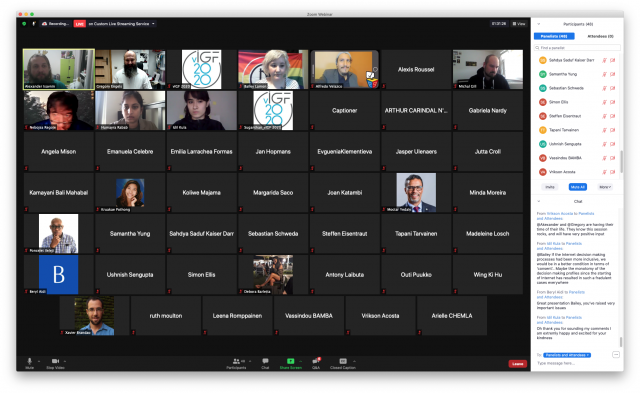
All panelists pledged to continue to work to forward the goals of the Internet Governance Forum and the Roadmap for Digital Cooperation, in particular towards the Digital Human Rights, ensuring the protection of human rights in the digital era.