About IGF
Internet Governance Forum
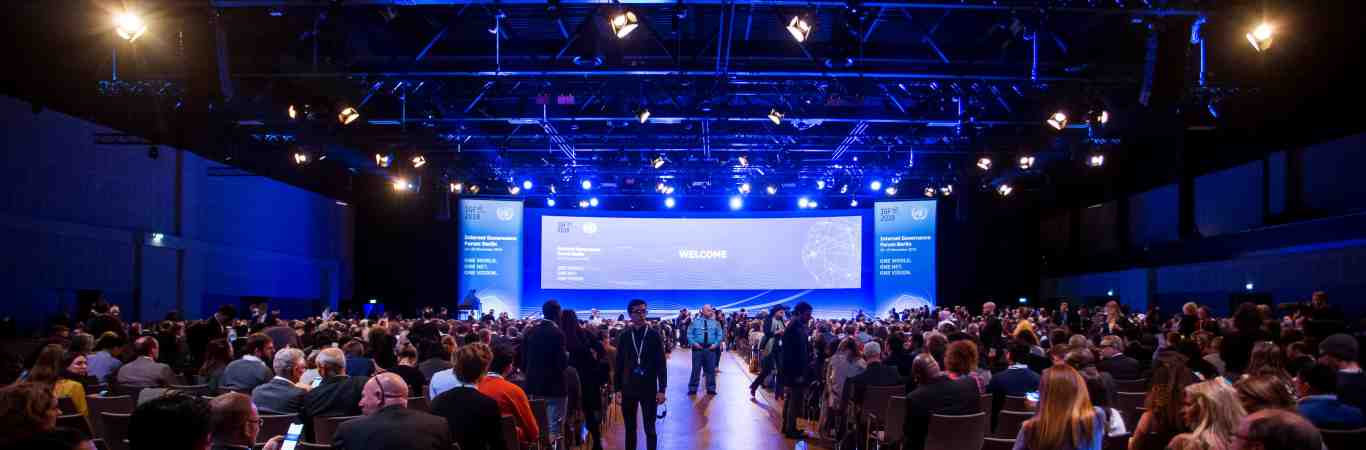
The United Nations Internet Governance Forum (IGF) serves to bring people together from various stakeholder groups in discussions on digital public policy. While it does not produce negotiated outcomes, the IGF informs and inspires those with policy-making power in both the public and private sectors. As a year-round process, the IGF includes policy, outreach, and community and capacity-building activities, all dedicated to facilitating a common understanding of how to maximise digital opportunities and address digital risks and challenges. IGF intersessional work culminates in annual meetings, where delegates discuss current and critical issues, share good practices and exchange policy recommendations with one another. The IGF’s resulting outputs are transmitted to global and national decision-making bodies.
Annual IGFs are convened by the UN Secretary-General and supported by a different host country each year. To date, twenty annual IGFs were hosed by different Governments. The 2025 IGF was held in Lillestrøm, Norway, following the 2024 IGF in Riyadh, Kingdom of Saudi Arabia. Annual IGF meeting reports 2026-2025 provide more information about each IGF cycle.
The IGF's mandate is set out in paragraphs 72 to 78 of the Tunis Agenda endorsed at the World Summit on the Information Society (WSIS) in 2005. The mandate was extended for a further ten years with the resolution adopted by the UN General Assembly on 17 December 2015 (80/173) 'Outcome document of the high-level meeting of the General Assembly on the overall review of the implementation of the outcomes of the World Summit on the Information Society'.
On 17 December 2025, the United Nations General Assembly confirmed the IGF as a permanent forum of the United Nations (Resolution 80/173).
For more information please refer to the ''About the IGF'' Brochure, the "IGF Achievements and Impact (2005-2025)" and the FAQs below.
FAQs – About IGF
What are the key public policy issues discussed at IGF?
The IGF covers a broad range of digital governance issues, from Cybersecurity and Meaningful Access to Data Privacy and Artificial Intelligence. Focus issues change yearly based on submissions received during the IGF’s public call for thematic inputs, ensuring that the emphasis remains on what stakeholders, including governments and their constituencies, wish to discuss.
For the IGF 2026 thematic orientation, please consult this page.
What have been the overarching themes of the annual IGF meetings?
2006 – “Internet Governance for Development”
2007 – “Internet Governance for Development – IGF the First Two Years”
2008 – “Internet for All”
2009 – “Internet Governance – Creating Opportunities for All”
2010 – “IGF 2010 – Developing the Future Together”
2011 – “Internet as a catalyst for change: access, development, freedoms and innovation”
2012 – “Internet Governance for Sustainable Human, Economic and Social Development”
2013 – “Building Bridges – Enhancing Multistakeholder Cooperation for Growth and Sustainable Development”
2014 – “Connecting Continents for Enhanced Multistakeholder Internet Governance"
2015 – “Evolution of Internet Governance: Empowering Sustainable Development”
2016 – “Enabling Inclusive and Sustainable Growth”
2017 – “Shape Your Digital Future!”
2018 – “Internet of Trust”
2019 – “One World. One Net. One Vision”
2020 – “Internet for human resilience and solidarity”
2021 – “Internet United”
2022 – “Resilient Internet for a Shared Sustainable and Common Future”
2023 – “The Internet We Want – Empowering All People”
2024 – ''Building our Multistakeholder Digital Future''
2025 – ''Building Digital Governance Together''
Who participates in the IGF?
The IGF’s multistakeholder format attracts strong participation from governments, the private sector, civil society, including academic experts, and the technical community. Dedicated tracks at the annual IGF meeting and related preparatory activities facilitate the engagement of government ministers (‘High-Level Track’, for government and senior-most officials from other stakeholder groups, such as industry executives); international legislators (‘Parliamentary Track’); and young people (‘Youth Track’).
Current and former heads of state or government have participated in the IGF’s ceremonial segments or as panellists.
Several UN agencies – ITU, OHCHR, UNESCO, UNFPA, UNFCCC, and WIPO, amongst them – and other intergovernmental organizations, such as the OECD and Council of Europe, are active in both the work between and during IGF annual meetings.
On average, annual IGF meetings attract over 9,000 onsite and online participants from all stakeholder and regional groups, from over 165 countries. For participation statistics in all IGF annual meetings, please consult the IGF annual reports available here.
What are the global, regional and national impacts of IGF?
Globally, the IGF facilitates understanding and agreement on digital public policy, governance mechanisms and new technologies; enhances cooperation among key organisations and stakeholders dealing with different digital domains; fosters maximal inclusion of stakeholders in the broader policy discourse, especially those from under-represented countries and groups; strengthens capacities for participation in digital policymaking at all levels of expertise and backgrounds; contributes to the continued sustainability, security and development of the Internet, including critical efforts at multilingualism and multistakeholderism.
Annual IGF Messages, as well as outputs from IGF-guided intersessional workstreams, such as Policy Networks and Best Practice Forums, and those from independent Dynamic Coalitions, are for global audiences and widely distributed.
The IGF has been and continues to be an active contributor to various international and intergovernmental processes, such as the WSIS process, the G7, and the Global Digital Compact, amongst others.
More than 175 countries and regions have established their own IGF National, Regional and Youth initiatives (NRIs) after the global IGF model – for processes that are multistakeholder, open, inclusive and bottom-up. The exponential growth of NRIs over the past decade testifies to the success and influence of the IGF approach. As digital technologies have taken on increasing importance in societies across the world, so has the need to discuss their impacts in people-centred, transparent fora. By supporting the development of the NRIs network, through organizational coordination and guidance from the IGF Secretariat, the global IGF has benefitted from vital local, national and regional-level perspectives on digital policy and the effects of digital transformation.
How is the IGF funded?
The IGF Secretariat, based in Geneva, is sustained financially through the extra-budgetary Trust Fund Account managed by the UN Department of Economic and Social Affairs (UN DESA). The nature of the IGF Trust Fund is such that it is voluntary and multi-donor driven, with varying contributions from governments and non-governmental organisations from the technical community, the private sector and civil society. The IGF Trust Fund covers the administrative and operational costs of the IGF Secretariat including personnel, fellowships, and meeting costs (venues, interpretation, logistical costs, etc.); and funds the travel costs of members of the IGF Multistakeholder Advisory Group (MAG) from developing countries. More details about the list of donors and funds received are available online. Each year, the organizational and conference costs of the IGF annual meeting are borne by the government of the host country. The UN General Assembly, in the WSIS+20 Resolution, called for ''appropriate staffing and resources, in accordance with United Nations budgetary procedures'' (A/RES/80/173, para 99). Internal arrangements to give effect to this provision are currently under consideration.
Who convenes and organises annual IGFs?
The IGF is convened by the UN Secretary-General.
The programme and intersessional work of annual IGFs is guided by the Secretary-General-appointed, 40-member Multistakeholder Advisory Group (MAG). In 2022, the IGF Leadership Panel, whose multistakeholder members are also appointed by the Secretary-General, was formed to provide high-level strategic advice to the IGF, address related urgent issues, and “promote greater impact and dissemination of IGF discussions”. The Panel is led by Google Vice-President and “Father of the Internet” Vint Cerf, and the 2021 Nobel Peace Prize Laureate Maria Ressa.
The MAG develops the IGF programme with support from the IGF Secretariat, and on the basis of regular public consultations and selection processes to determine timely themes and formats.
How are IGF host countries selected?
Countries approach the IGF Secretariat with their interest in hosting for given years. Strong interest may be formalized in writing as an offer letter and submitted to the UN Department of Economic and Social Affairs (UN DESA), the Secretariat’s parent department. The Secretariat evaluates all formal offers received and makes a decision based on the suitability of facilities and conditions for hosting, as well as on the need to rotate among regions and between developing and developed countries. More information about the expression of interest and the related assessment is available here.
Which countries have hosted the previous IGFs?
The host countries of the past 20 IGFs have been:
- 2006: Athens, Greece
- 2007: Rio de Janeiro, Brazil
- 2008: Hyderabad, India
- 2009: Sharm el Sheikh, Egypt
- 2010: Vilnius, Lithuania
- 2011: Nairobi, Kenya
- 2012: Baku, Azerbaijan
- 2013: Bali, Indonesia
- 2014: Istanbul, Turkey
- 2015: João Pessoa, Brazil
- 2016: Jalisco, Mexico
- 2017: Geneva, Switzerland
- 2018: Paris, France
- 2019: Berlin, Germany
- 2020: hosted virtually by the UN
- 2021: Katowice, Poland
- 2022: Addis Ababa, Ethiopia
- 2023: Kyoto, Japan
- 2024: Riyadh, Saudi Arabia
- 2025: Lillestrøm, Norway
Get Started
Team
Donors to the IGF Trust Fund
The Internet Governance Forum Secretariat is funded through donations from various stakeholder groups. While host countries bear the majority of the costs associated with holding the annual IGF meeting, the IGF Secretariat's activities are funded through extra-budgetary contributions paid into a multi-donor Trust Fund administered by the United Nations Department of Economic and Social Affairs (UNDESA). All contributions are administered and accounted for in accordance with United Nations Financial Rules and Regulations and other applicable directives, procedures and practices.
Contributions from all stakeholders are welcome, including in-kind donations.
The Secretariat is grateful to IGF Trust Fund donors, listed below in order of the size of their total contribution since 2006.
Government of Finland
European Commission
Government of Germany

Internet Corporation for Assigned Names and Numbers (ICANN)

Number Resource Organization (NRO)
Government of Switzerland

The Internet Society (ISOC)

Government of the Netherlands

Government of the United Kingdom

Government of the United States

Government of Japan

Nominet UK

Verizon

Tides Foundation

Brazilian Internet Steering Committee
IGFSA

AT&T

China Energy Fund Committee

Verisign

Meta

Afilias Global Registry Services
The Internet Society Foundation

Government of Portugal - Fundacao Para a Ciencia e a Tecnologia

European Registry for Internet domains (EURid)

Microsoft Corporation

Siemens Aktiengesellschaft - Communications / Nokia Siemens Networks


Government of Norway

Government of Sweden

Amazon

UNINETT Norid

The Swiss Education & Research Network (SWITCH)

The Walt Disney Company

CISCO

auDA Australia's Domain Name Administrator

International Chamber of Commerce (ICC) - Business Action to Support the Information Society (BASIS)

Coordination Center for TLD RU

Danish Internet Forum

Politecnico di Torino

Community DNS
Government of the Republic of Korea
European Telecommunication Network Operators' Association

MCADE, LLC.

NIC-MEXICO

Nic.at The Austrian Registry

Summit Strategies International

NIKKEI DigitalCORE

Ribose Inc
In Kind Contributions

Internet Corporation for Assigned Names and Numbers (ICANN)
(Covers transcription for MAG Face-To-Face Meetings)

IGFSA
(Covers transcription for MAG and Dynamic Coalitions Virtual Meetings

ITU
(Provides remote participation for one face to face meeting)

(Provides extended Youtube Account for Sessions Videos)

CISCO
(Provides WebEx Tool for Virtual Meetings)
Work with us
The IGF fellowship programme provides an opportunity for those active in the field of Internet governance, to work at the IGF Secretariat for up to nine months. The nominations should be submitted through national and regional IGF initiatives. Preference is given to nominees from least developed Countries (LDC's), developing countries and transitional economies. Names submitted through this process are kept on a roster. Unfortunately due to the large number of applications the Secretariat can only contact those that are shortlisted in a particular cycle. For further information about the fellowship programme please contact the IGF Secretariat at igf[at]un.org
Contact Us
Secretariat of the
Internet Governance Forum (IGF)
Palais des Nations,
CH-1211 Geneva 10, Switzerland
+41 (0) 229 173 411